Mullvad VPN
- 4.1
- Rating
- 5.00M
- Installs
- Free
- Price

 Analysis by App-foxy
I have always judged a VPN less by its promise of “fast” browsing and more by how little it gets in the way of ordinary tasks. That is the useful way to look at Mullvad VPN: it is a privacy-focused tools app from Mullvad VPN AB, available for free download, with optional in-app purchases ranging from $5.99 to $17.97 per item. I found its appeal strongest when I wanted a clear, uncomplicated privacy layer rather than a crowded app full of extras.
The Android release arrived on May 4, 2021, and the current version is 2026.2. It runs on Android 8.0 or later, carries an Everyone age rating, and has passed one million installs. Its average score is 4.3 from around 7.3 thousand ratings, with roughly 796 written reviews. Those figures suggest a well-established app, but they do not replace the more important question: does it behave sensibly when a connection is slow, a phone is busy, or a VPN session needs to recover?
How Mullvad VPN feels in everyday use
I find Mullvad VPN most useful when it becomes a small, deliberate part of a routine rather than something I switch on and then forget about. A quick check of the connection before sensitive browsing can help me decide whether protection or the lowest possible delay matters more in that moment. That practical choice also sets up a closer look at how the app fits into ordinary phone use.
You May Also Like

 Blood Strike: 2.5 Anniversary
Blood Strike’s Loadouts Turn Every Drop Into a Tactical Gamble
A close look at Blood Strike’s custom loadouts: how fast access to signature weapons reshapes its battle royale rhythm, rewards preparation, and narrows the gap between fights.

 Pandora - Music & Podcasts
Pandora’s Music Is Easy to Start, but Harder to Recover
Pandora’s strength is its low-effort path from a seed to a station. Its weak spot is how much confidence it asks you to place in connection, setup, and quiet recovery.

 8 Ball Pool
 Is Built on Rivalries, Rematches, and Routine
A close look at the rivalries, rematches, shared routines, and unanswered safety questions that turn a quick pool match into a persistent mobile community.

 Samsung Music
’s Quiet Strength Is Playing What You Already Own
Its reach comes less from spectacle than from dependable access to a personal library. That simplicity is both the app’s strongest retention engine and its ceiling.

 AccuWeather: Weather Radar
AccuWeather Review: A Quick, Clear Forecast for Everyday Decisions
For everyday plans, the best forecast is the one you can understand quickly. AccuWeather makes rain timing, radar, and local conditions easy to act on, with a few trade-offs.

 Hill Climb Racing
Why Hill Climb Racing Still Turns Crashes Into One More Run
A tiny car, a bumpy hill and one more upgrade: Hill Climb Racing keeps resurfacing because its simple chaos makes every near-miss feel personal.
More From Our News Desk



Speed expectations without unrealistic promises
My first impression is that Mullvad VPN is designed to keep the main action easy to understand. You open it, choose a connection, and expect the app to establish a protected route without turning the process into a technical project. That simplicity matters because a VPN is most useful when I can switch it on before checking email, joining public Wi-Fi, or opening an app that handles personal information.
I would not treat the word “fast” in the store summary as a guarantee that every connection will match an unprotected one. VPN performance depends on the distance to the selected server, the quality of the mobile network, local congestion, and what the destination service is doing at that moment. The honest expectation is that Mullvad VPN should be judged by whether the slowdown feels acceptable for the task, not by assuming that the VPN can remove every bottleneck.
For reading articles, messaging, browsing maps, and handling ordinary account pages, a small change in responsiveness is usually easier to accept than the uncertainty of using open wireless networks without protection. Video calls and large downloads are more demanding. In those situations, I would connect before starting the task, give the session a moment to settle, and avoid changing locations repeatedly while data is moving.
One useful habit is to separate a connection problem from an app problem. If a page is slow, I first check whether the phone’s underlying network is already struggling. If the connection improves after temporarily switching to another location, the issue may be route congestion rather than the handset or the website. This simple comparison is more informative than repeatedly tapping the connect button.
What happens during heavy use
The most revealing moments for a VPN are not short browsing sessions but mixed periods of use. Imagine sitting in a café, moving between a video call, cloud documents, and a few photo uploads while the phone is also receiving notifications. In that situation, the VPN has to remain unobtrusive while the network changes in quality. Mullvad VPN makes sense for this kind of routine because its purpose is focused: protect the connection rather than compete with the apps I am actually using.
Heavy traffic can expose trade-offs that are invisible during a quick test. A protected connection may feel less responsive when uploading a large file, and a busy route can make a streaming service take longer to begin playback. I would not use a VPN as a way to improve a weak signal. Instead, I use it as a privacy decision, accepting that the safest route may not always be the shortest or quickest one.
Gaming is another case where expectations matter. A VPN can be useful when privacy is a priority, but latency-sensitive games may react badly to any extra routing. If a game already feels smooth, I would not automatically place it behind the VPN just because the app is available. On the other hand, when I am using an unfamiliar network and prefer protection over the lowest possible delay, the trade-off may be worthwhile.
Battery and memory are also part of the heavy-use question. I would expect any VPN that stays active in the background to have some effect on a phone’s resources, although the practical impact depends on the device, network, and how long the connection remains active. On an older handset, I would watch for unusual battery drain or heat during a long session instead of assuming that every phone will behave identically.
Reliability and recovery when the network changes
A VPN earns trust through predictable behavior after interruptions. Mobile users regularly leave Wi-Fi, enter an elevator, lose signal on public transport, or move from one access point to another. A connection that works perfectly at home but becomes confusing after a network change is not truly convenient, so I pay attention to whether the app makes the current state understandable.
My practical advice is to check the app after a major network transition rather than assuming that a previous session is still active. This is especially important when I move from a private home network to public Wi-Fi. The useful workflow is simple: connect before sensitive activity, confirm that the session is active, and reconnect if the phone has clearly lost its network.
Recovery can also involve the destination service rather than the VPN itself. Some websites and apps may react differently when the connection appears to come from another location. A login challenge, a slower page, or a service that refuses the route does not automatically mean Mullvad VPN is broken. If a particular service is essential, I would test it before relying on the VPN during travel or work.
This is one area where a focused VPN can be preferable to a security suite packed with unrelated controls. I am less likely to overlook the connection status when the interface is centered on the VPN task. The trade-off is that users who want antivirus scanning, password management, parental controls, or a large collection of bundled privacy tools may prefer a broader alternative.
Device limits and the Android experience
Android 8.0 is the minimum operating system, which gives the app a useful reach across older phones while still setting a clear boundary for very old hardware. Before installing, I would check the Android version in the phone’s settings, particularly if the device has been kept for many years. A compatible operating system does not necessarily mean identical performance, though: an older processor, limited storage, or a worn battery can make any always-on network tool feel heavier.
The Everyone rating makes the app approachable for general users, but privacy tools still need sensible habits. I would explain to a less technical family member that connecting the VPN does not make every online action automatically safe. It does not replace careful passwords, software updates, or judgment about suspicious messages. Its role is narrower and clearer: it adds a protected VPN connection when enabled.
Resource-conscious users should think about when they need it. Keeping the VPN active throughout the day may be convenient, but connecting only for public networks, travel, banking, or other sensitive sessions can be a reasonable compromise if battery use is a concern. I prefer that flexible approach on a secondary phone or an older device, where background activity is more noticeable.
The purchase model deserves attention before installation. The app itself is free to download, while in-app purchases are listed between $5.99 and $17.97 per item. I would check the purchase screen carefully and decide whether the available plan suits my usage before treating the app as a permanent part of my phone setup. That is particularly important for someone comparing it with a VPN already included in another subscription.
Where it beats familiar alternatives, and where it does not
Compared with a free VPN that relies heavily on advertising or pushes a collection of unrelated features, Mullvad VPN is attractive because the experience feels more purpose-built. I would choose it when the priority is a straightforward privacy tool and when I am willing to accept that a VPN can introduce routing and compatibility trade-offs.
Compared with a large commercial VPN package, the decision is less obvious. A broader service may be better for someone who wants an all-in-one security bundle, many entertainment-oriented options, or a highly guided experience for the whole household. Mullvad VPN is a better fit for someone who wants to keep the job separate: one app for VPN protection, other tools for other security needs.
It is also not the right choice for every performance-sensitive task. If my main goal were the lowest possible latency in a competitive game, the cleanest video-call quality, or maximum download speed on a reliable private connection, I would test the task both with and without the VPN. If the difference matters, I would use the VPN selectively rather than leaving it enabled by habit.
Another trade-off appears when a service depends on location consistency. Travel booking, financial services, streaming platforms, and workplace systems can sometimes behave differently when traffic comes through a VPN. I would not assume that every site will work exactly as it does on a direct connection. Testing important services in advance is more sensible than discovering a compatibility issue during a deadline.
Small workflows that make the app more useful
The first workflow I recommend is a public-network check. Before opening a work account or sending a private message from a hotel, airport, library, or café, I connect the VPN and verify the active state. When I leave that network, I reassess whether I still need the connection. This avoids both extremes: forgetting protection when it matters and leaving a demanding connection running unnecessarily.
The second is a controlled speed comparison. I choose one ordinary task, such as loading the same news page or starting a familiar video, and compare the experience with the VPN connected and disconnected. I do this at the same place and around the same time, because comparing different networks produces misleading conclusions. If a chosen location feels sluggish, I try another rather than blaming the entire app.
The third is a recovery routine for travel. When moving between mobile data and Wi-Fi, I avoid beginning a sensitive task immediately after the network changes. I wait for the phone to show a stable connection, open Mullvad VPN, and confirm the session again. This takes little time and prevents the common mistake of assuming that a previously connected VPN session survived every interruption.
A fourth tip is to avoid using one setting for every activity. Privacy needs are high on unfamiliar networks, while latency may matter more during a competitive game or a live call. Treating the VPN as a tool I can use deliberately makes the experience more balanced than leaving it on without considering what the phone is doing.
Who should install it?
I would recommend Mullvad VPN to Android users who want a focused privacy app, prefer a relatively uncluttered purpose, and understand that protection can involve a small performance or compatibility compromise. It is especially sensible for people who frequently use public Wi-Fi, travel with a phone, or want a simple way to add a VPN layer before handling personal information.
I would be more cautious about recommending it to someone whose only concern is maximum speed. If the phone is already old, the battery is weak, or the user spends most of the day in latency-sensitive games and calls, the added network route may not be worth the trade-off. I would also point heavy bundle seekers toward a broader security product if they want several protections in one subscription.
The app’s free download, Everyone rating, and support for Android 8.0 or later make it easy to consider, but ease of access should not be confused with universal suitability. The right decision depends on whether privacy during a particular connection matters more than absolute speed, stable location behavior, or minimal background activity.
My performance verdict
After looking at the app through speed, heavy use, recovery, and device demands, I see Mullvad VPN as a practical privacy tool rather than a performance enhancer. Its strongest quality is focus: I can understand why I am using it and build it into ordinary routines without needing a complicated security setup.
The most realistic expectation is steady, comfortable use for browsing, messaging, account access, and public-network protection, provided the underlying connection is healthy. More demanding activities deserve a quick comparison because routing can affect responsiveness, downloads, calls, and games. That is not a reason to dismiss the app; it is the normal trade-off of adding a VPN to the path between a phone and the internet.
With over one million installs and a 4.3 average, it has clearly found an audience, while the current 2026.2 release shows that the Android app remains an active option. I would choose it when privacy and a focused interface matter more to me than a large package of extras. My recommendation is to use it deliberately: connect before sensitive activity, check it after network changes, and turn it off when a task genuinely depends on the lowest possible latency.
FAQs for Mullvad VPN
01What platforms is Mullvad VPN available on?
Mullvad VPN is available on a wide range of platforms, including Windows, macOS, Linux, iOS, and Android. This ensures that users can maintain their privacy across all their devices. Additionally, Mullvad offers manual configuration options for routers, so you can protect your entire home network.
02How does Mullvad VPN ensure user privacy?
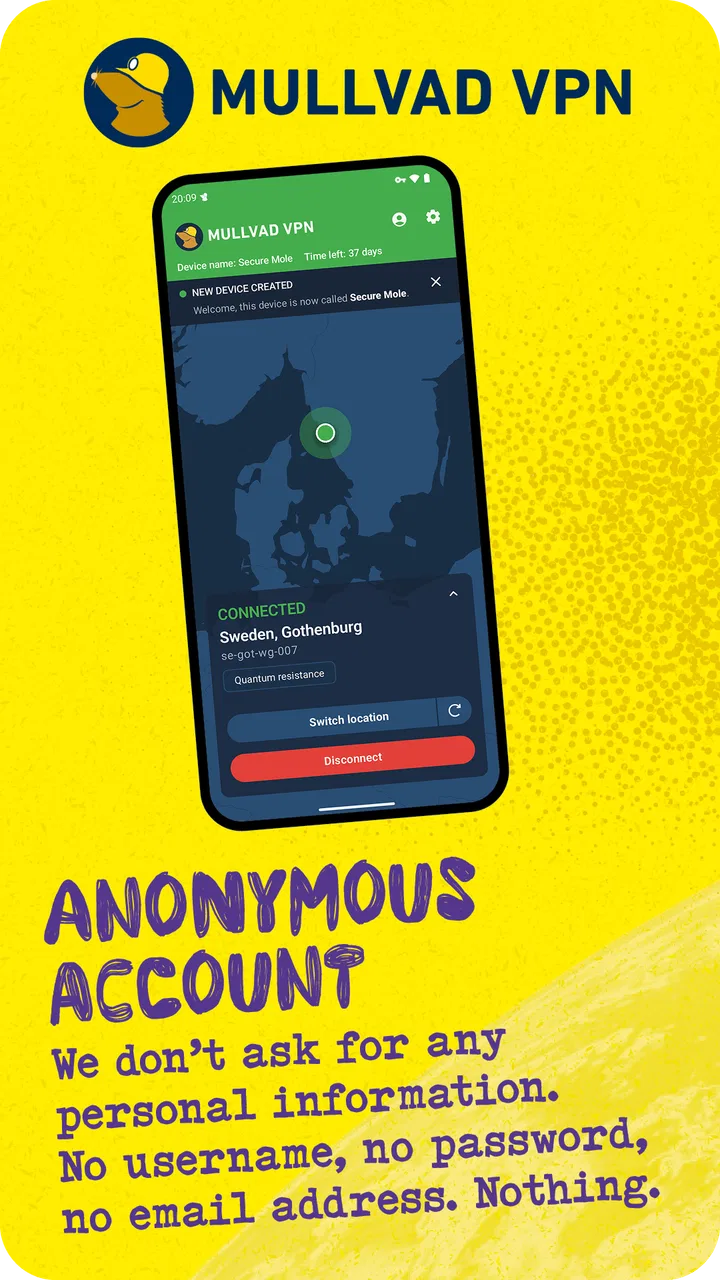
Mullvad VPN prioritizes user privacy by not requiring any personal information to create an account. Users are assigned a unique account number instead of using an email or password. Furthermore, Mullvad has a strict no-logs policy, meaning they do not keep any records of user activity or connection data.
03Is Mullvad VPN easy to use for beginners?
Yes, Mullvad VPN is designed with user-friendliness in mind. The app interface is straightforward, making it easy for beginners to navigate. Users can connect to a server with a single click. Additionally, Mullvad offers extensive documentation and support to assist users who may need help setting up or using the service.
04What are the key features of Mullvad VPN?
Mullvad VPN offers robust features such as high-level encryption, DNS leak protection, and a kill switch to ensure your internet traffic is secure. Users can connect to servers in over 35 countries, and the service supports up to five simultaneous connections. Mullvad also offers port forwarding for advanced users.
05Does Mullvad VPN offer a free trial or money-back guarantee?
Mullvad VPN does not offer a free trial, but they do provide a 30-day money-back guarantee. This allows users to test the service risk-free. If you're unsatisfied for any reason, you can request a refund within the 30-day period. Payments can be made anonymously via cash, Bitcoin, or traditional methods like credit cards.
Pros
- Strong privacy protection policies.
- No-log policy ensures anonymity.
- Simple and user-friendly interface.
- Accepts anonymous payments.
- High-speed servers available.
Cons
- Limited server locations worldwide.
- No free trial available.
- No native app for iOS devices.
- Occasionally slow customer support.
- No advanced features for experts.

Mullvad VPN
Gallery